
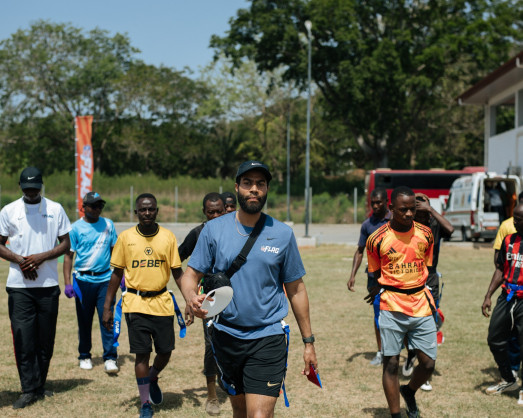

The National Football League (NFL) (https://NFL.com/International), in collaboration with the International Federation of American Football (IFAF), hosted a four-day series of flag football development clinics in Ghana, bringing together local educators, international coaches and global federation representatives as part of ongoing efforts to grow the game worldwide and expand access to flag football across Africa.
The programming included a Ghana-based teachers clinic focused on equipping local educators with the tools and resources to introduce and scale flag football in schools, followed by an Africa Coaching Clinic delivered in collaboration with IFAF and its member federations from across the continent. Participating countries included Ghana, Cameroon, Egypt, Ivory Coast, Kenya, Morocco, Nigeria, Senegal, South Africa, Tunisia and Uganda.
Together, the sessions emphasized both grassroots access and high-performance development, reflecting the NFL and IFAF’s shared commitment to building sustainable pathways for flag football at all levels of the game.
Flag football is one of the fastest-growing sports globally, with millions of players participating across more than 100 countries. As the sport continues to expand internationally — including its upcoming debut at the Olympic Games in Los Angeles in 2028 — the NFL and IFAF are working together to increase access, strengthen development pathways and support national federations around the world.
“Flag football continues to create new opportunities for athletes and communities around the world,” said Afia Law, International Flag Football Development Manager, NFL. “Through this work in Ghana, we’re proud to support local educators and coaches while also partnering with federations across Africa to expand access to the game and build sustainable pathways for growth across the region.”
The four-day programming began with two days of locally focused development in Ghana, including a teachers clinic that provided a free opportunity for approximately 40 educators involved in the NFL Flag program. Sessions focused on building coaching frameworks, developing sustainable school-based programs and introducing game fundamentals, with on-field drills and gameplay offering participants hands-on experience in implementing what they learned.
Tshe final two days expanded to an international focus, as the Africa Coaching Clinic brought together IFAF delegates and coaches from across the continent for on-field instruction, collaboration and knowledge-sharing. Participating countries included Ghana, Cameroon, Egypt, Ivory Coast, Kenya, Morocco, Nigeria, Senegal, South Africa, Tunisia and Uganda. The sessions also featured participation from a retired Olympic sprinter from Sierra Leone, underscoring the increasing connection between flag football and the Olympic movement.
“Programs like this demonstrate the power of collaboration in driving the global development of flag football,” said Lars Carlsen, IFAF Sport Manager. “By working together with partners like the NFL, we are able to support national federations, strengthen coaching structures and continue building momentum for the sport as it grows internationally and moves toward its Olympic future.”
Coaches participating in the clinics also had the opportunity to engage directly with peers from other countries, fostering cross-border collaboration and strengthening the broader flag football ecosystem across Africa.
The Ghana programming builds on ongoing NFL and IFAF efforts to expand flag football globally, with a focus on accessibility, inclusion and long-term development pathways for athletes and coaches alike. Flag football is also seeing rapid growth across Africa, with IFAF member federations across the continent reporting significant increases in participation in recent years, reflecting strong local momentum and continued investment in the sport.
Distributed by APO Group on behalf of National Football League (NFL).


