

West Africa is marking the fifteenth anniversary of the Ouagadougou Partnership (OP) this year. Launched in February 2011 in Ouagadougou (Burkina Faso), this unique regional cooperation framework has helped place family planning at the heart of public health priorities in nine West African countries (Benin, Burkina Faso, Côte d’Ivoire, Guinea, Mali, Mauritania, Niger, Senegal and Togo).
Fifteen years after its creation, the Ouagadougou Partnership has established itself as a regional space for dialogue, mobilisation and collective action, bringing together governments, civil society, young leaders, implementing partners, donors and researchers around a shared ambition: to advance rights and access to sexual and reproductive health and family planning in French-speaking West Africa.
Over fifteen years, the OP has contributed to major advances: stronger national policies, greater mobilisation of domestic and external resources, improved service provision and sustained advocacy for sexual and reproductive health and rights / family planning (SRHR/FP). Thanks to the commitment of the nine member countries, the number of female users of modern contraceptive methods has risen significantly, creating a regional momentum that must now be accelerated to reach 13 million female users by 2030. (https://apo-opa.co/4hpnahi)
A few cumulative figures over 15 years:
- Around 30.3 million unintended pregnancies averted;
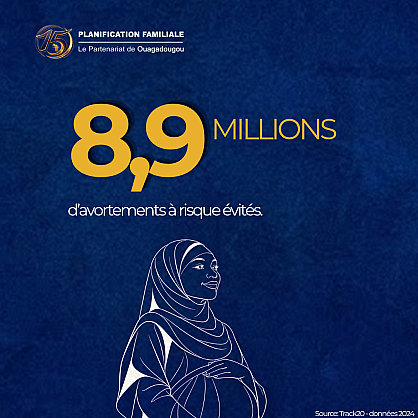
- Around 8.9 million unsafe abortions averted;
- Around 1.8 million maternal deaths averted;
- Around 4 million additional users of modern contraceptive methods.
Beyond these figures, these advances reflect fifteen years of collective mobilisation to enable more people, particularly women and young people, to have the information, services and choice they need to decide freely about their reproductive health.
“These fifteen years show what can be achieved when countries, civil society, young leaders, researchers and partners work hand in hand. Our responsibility today is to preserve these gains while accelerating our efforts so that the 2030 ambitions translate concretely into the lives of women and young people in West Africa.” Marie Ba, Director of the Ouagadougou Partnership Coordination Unit.
This celebration is an opportunity to highlight a regional dynamic: all nine OP countries (https://apo-opa.co/4jCRc2q) can count on National family planning action plans (PANB-PF) or National plans for reproductive, maternal, newborn, child, adolescent and older people health (SRMNIA) under implementation or renewal, which supports better planning and integration of family planning policies.
In 3 of the 9 countries (Niger, Burkina Faso and Côte d’Ivoire), access to family planning methods is completely free of charge across the entire national territory, and the possibility of free access is under consideration in Guinea. In the remaining countries, access is made possible through relatively controlled costs.
Some achievements, by country
|
Benin (https://apo-opa.co/4rJkb6J) |
Burkina Faso (https://apo-opa.co/4rMlKAV) |
Côte d’Ivoire (https://apo-opa.co/3VrJWg4) |
|
Guinea (https://apo-opa.co/3Vv9wAH) |
Mali (https://apo-opa.co/3ViXlqG) |
Mauritania (https://apo-opa.co/4jFAjUR) |
|
Niger (https://apo-opa.co/4jCR8zI) |
Senegal (https://apo-opa.co/4rK4b4u) |
Togo (https://apo-opa.co/4hDuQNb) |
In 2022, the OP also adopted a “research agenda” aimed at informing the decisions of national authorities and partners with locally produced evidence (https://apo-opa.co/4huE0eP); eight research projects, led by West African institutes, have already been funded and their findings now help to steer public family planning policies in practical terms.
This determination to bring research closer to public decision-making is also a key focus of the OP: producing knowledge rooted in West African realities and ensuring that it can feed into policies, financing and programmes.
In 2023, the Annual Meeting of the Ouagadougou Partnership, held in Côte d’Ivoire, was marked by an announcement that made history: the Ivorian Prime Minister raised the national budget for the procurement of family planning products from 400 million to 2.5 billion XOF. This decision illustrates the growing importance of mobilising domestic resources to ensure the sustainability of progress in family planning. In Mali, an employers’ fund has been set up to support reproductive health and family planning. As 2030 approaches, the challenge will be not only to mobilise more national financing, but also to ensure that the commitments made translate durably into budgets and public policies. This is the context for the Ouagadougou Partnership’s ministerial round table held on the margins of the 81st United Nations General Assembly, which was attended by ministers of health and finance.
The Ouagadougou Partnership is much more than a regional initiative: it is a coalition of actors (governments, civil society and technical and financial partners) united around a common cause. Each, at its own level, mobilises its expertise and its resources to reduce the unmet need for family planning in West Africa. Its strength lies in this ability to bring actors together around shared priorities, to foster accountability and to turn political commitments into concrete action for women, young people and communities.
Now in its fifteenth year, the OP is therefore entering a new chapter in its history. While significant progress has been made, unmet need for family planning persists, and the regional context calls for preserving gains even as efforts are accelerated.
The course set for 2030 is clear: to reach 13 million users of modern contraceptive methods, while contributing to Sustainable Development Goal 3 and to equitable access to quality sexual and reproductive health services based on rights and free choice.
This ambition reminds us that family planning is not solely a health matter. It affects the lives of women and girls, their educational opportunities and their participation in economic and social life. It therefore contributes more broadly to the development of our countries, in particular to gender equality, poverty reduction, governance and sustainable development.
The next five years will be decisive. The Partnership calls for strengthening the mobilisation of domestic resources, preserving access to services in all contexts, better integrating the needs of young people, supporting civil society organisations and continuing to make data and research tools serving public decision-making.
The OP invites all its stakeholders — states, civil society, implementing partners, donors, media, young people and researchers — to pursue their efforts so that every woman and every young person, wherever they live in West Africa, can fully exercise their rights and access quality services that meet their needs and aspirations.
Distributed by APO Group on behalf of Speak Up Africa.
For further information, please contact:
Ms Armelle Nyobe
Communications Manager – UCPO
anyobe@partenariatouaga.org
Ms Jensiah Ohouo
Communications Officer – UCPO
johouo@partenariatouaga.org


