
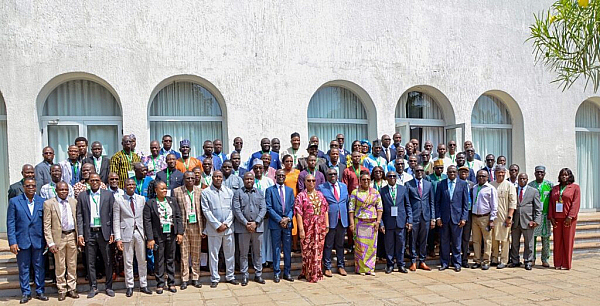
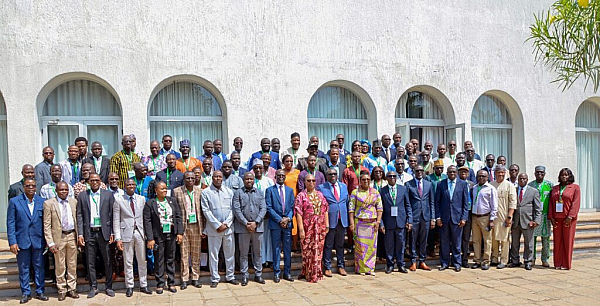
Building a community capable of anticipating health crises, detecting threats early, sharing information quickly, and responding in a coordinated and effective manner.This is the aspiration expressed by the Resident Representative of the Economic Community of West African States (ECOWAS) Commission, in Togo, Ms. Deweh Emily Gray, on Tuesday, October 6, 2026, in Lomé, the Togolese capital, at the opening of the 11th annual meeting of animal health networks on the theme “Strengthening the Surveillance and Control of Transboundary Animal Diseases in the ECOWAS Region.”
For Ms. Deweh Emily Gray, the choice of this theme speaks for itself, as it reflects ECOWAS’s commitment to protecting animal resources, supporting the economic development of its member states, and promoting regional integration.
Among animal resources, she cited livestock farming, which is a vital component of West Africa’s agricultural economy, noting that it contributes significantly to food and nutritional security and serves as an important source of income for local populations.
“However, this vital sector remains exposed to persistent and re-emerging threats related to transboundary animal diseases, including Small Ruminant Peste (SRP), Contagious Bovine Pleuropneumonia (CBPP), Foot-and-Mouth Disease, Avian Influenza, and Rabies,” stated Ms. Deweh Emily Gray.
Echoing this sentiment, the Togolese Minister of Agriculture, Livestock, Fisheries, and Food Sovereignty, through his Chief of Staff, Dindiogue Konlani, outlined several approaches to better address these threats.
“In the face of these health threats, no country can succeed on its own. The fight against animal diseases is, by its very nature, a matter of solidarity and collective action,” he suggested.
Both Dindiogue Konlani and Ms. Deweh Emily Gray urged participants to engage in constructive and fruitful discussions that would lead to relevant recommendations for further strengthening the surveillance and control of epizootics.
For their part, the representative of the Food and Agriculture Organization of the United Nations (FAO), Lionel Gbaguidi, and the director of the African Union’s Inter-African Bureau for Animal Resources (AU-BIRA), Dr. Huyam Salih—represented by the Regional Coordinator for the Control and Eradication of Small Ruminant Peste in West Africa, Dr. Perdita Hilary Lopes—expressed their gratitude to ECOWAS and the Regional Animal Health Center (CRSA) for their consistent leadership in promoting regional cooperation on animal health.
They reiterated their commitment to working with ECOWAS, its member states, and regional institutions to strengthen coordinated action against transboundary animal diseases, support veterinary laboratories, and develop information systems capable of providing reliable data for rapid and coordinated decision-making.
The objectives of this meeting are to consolidate regional animal health governance, strengthen coordination among the various stakeholders, and adopt strategic and operational tools essential for the prevention, early detection, and control of transboundary animal diseases.
Participants include heads of veterinary services, presidents of national veterinary associations, and focal points for the regional networks of animal health laboratories (RESOLAB) and epidemiological surveillance (RESEPI) from ECOWAS and Sahel member states.
Representatives from the Regional Animal Health Center (CRSA), the West African Health Organization (OOAS), and the ECOWAS Regional Disease Control Center, as well as technical and financial partners, are also participating in the proceedings.
In particular, they will review and adopt the electronic platform of the Regional Animal Health Information System (SRISA), developed by the CRSA to improve the collection, analysis, sharing, and use of animal health data for rapid and coordinated decision-making.
On the sidelines of the meeting, a gathering of ECOWAS ministers responsible for animal health will be held to approve regional strategies for the protection and conservation of donkeys by 2030, for the prevention and control of foot-and-mouth disease in West Africa (2026–2030), and for the prevention and control of highly pathogenic avian influenza and related action plans (2026–2031).
This 11th annual meeting of the animal health networks is organized by the Regional Animal Health Center (RAHC), a specialized agency of the ECOWAS Commission. Originally based in Bamako, Mali, it is now located in Bissau, Guinea-Bissau.
Established in 2012, the CRSA is responsible for strengthening regional cooperation on animal health and welfare. Its primary mission is to coordinate and harmonize the policies and interventions of ECOWAS member states in the prevention and control of transboundary animal diseases and zoonoses.
Distributed by APO Group on behalf of Economic Community of West African States (ECOWAS).


