
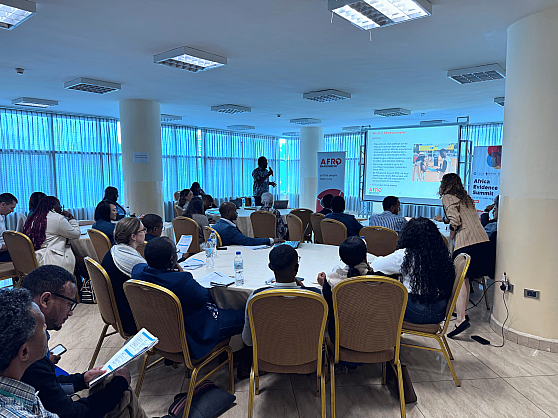

Afrobarometer (www.Afrobarometer.org) highlighted the value of citizen-generated data for policy making through a hands-on technical workshop at the 2026 Africa Evidence Summit in Addis Ababa, Ethiopia, on 23-24 July 2026.
Convened by the Center for Effective Global Action (CEGA), the Network of Impact Evaluation Researchers in Africa (NIERA), and the Policy Studies Institute (PSI), the summit gathered more than 400 researchers, scholars, policy makers, civil society organisations, and development practitioners to strengthen the use of evidence in policy making across Africa.
“Each year, this summit brings together a diverse community spanning disciplines, sectors, and continents to explore how high-quality research in Africa can inform policy making across the continent,” said Carson Christiano, executive director of CEGA. “Together, we have the opportunity to build a more connected, evidence-informed ecosystem, equal to the complexity of the challenges ahead.”
In her keynote address, Fitsum Assefa, Ethiopia’s minister of planning and development, emphasised the importance of high-quality data for development.
“To achieve our national goals and Africa’s Agenda 2063, we need reliable, real-time evidence,” she said. “Strengthening our data systems is essential. We should actively build a culture in which data are routinely collected, transparently shared, and effectively used to guide policy from start to finish.”
During the technical workshop, Kamal Yakubu, Afrobarometer’s capacity-building manager (advanced track), and Daniel Iberi, Afrobarometer’s communications coordinator for East Africa, guided participants through Afrobarometer’s survey methodology, thematic and geographical scope, and online data analysis tool. The workshop also equipped participants with practical skills in accessing, analysing, and applying Afrobarometer data for research, advocacy, and development programming.
“Attending the Afrobarometer workshop reinforced how valuable these data are,” said workshop participant Juba Kafumba, a doctoral student in public policy at the University of North Carolina. “I’ve relied extensively on Afrobarometer data sets in my past research because they help turn raw numbers into meaningful stories that can inform evidence-based policy. If you want to move beyond simply looking at data to truly understand what citizens are experiencing, these data sets are unmatched.”
Afrobarometer also presented a poster highlighting survey findings on climate change, demonstrating that Africans’ lived experiences and perceptions offer important evidence for climate research, adaptation planning, and policy responses.
The 2026 Africa Evidence Summit was the 14th edition. These summits are annual in-person gatherings that bring together African scholars, policy makers, and practitioners to discuss the latest research on economic development and poverty alleviation in Africa. The summit also promotes discussion of new ways to integrate evidence into decision making, elevate African scholars’ voices, and engage stakeholders in the process.
Distributed by APO Group on behalf of Afrobarometer.
For more information, please contact:
Daniel Iberi
Afrobarometer communications coordinator for East Africa
Telephone: +254725674457
Email: diberi@afrobarometer.org
Social Media:
Facebook
X
LinkedIn
YouTube
Instagram
Whatsapp
Bluesky
Follow our releases on #VoicesAfrica
About Afrobarometer:
Afrobarometer (AB) is a trusted source of high-quality data and analysis on what Africans are thinking. With an unmatched track record of 440,000+ interviews in 45 countries, representing the views of more than 75% of the African population, AB is leading the charge to bridge the continent’s data gap. AB data inform many global indices, such as the Ibrahim Index of African Governance, Transparency International’s Global Corruption Barometer, and the World Bank’s Worldwide Governance Indicators. The data are also used for country risk analyses and by credit rating and forecasting agencies such as the Economist Intelligence Unit. All AB data sets are publicly available on the website (www.Afrobarometer.org) and may be analysed free of charge using AB’s online data analysis tool (https://apo-opa.co/4pGmlmB).
Visit us online at www.Afrobarometer.org


