
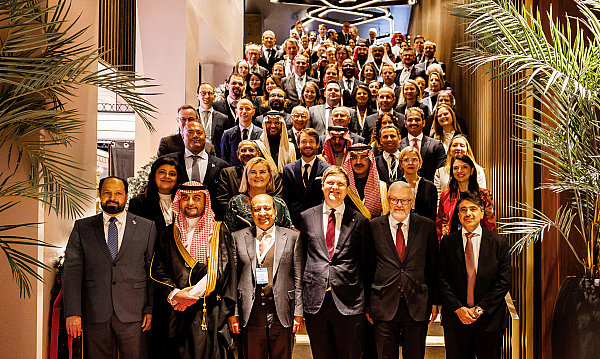
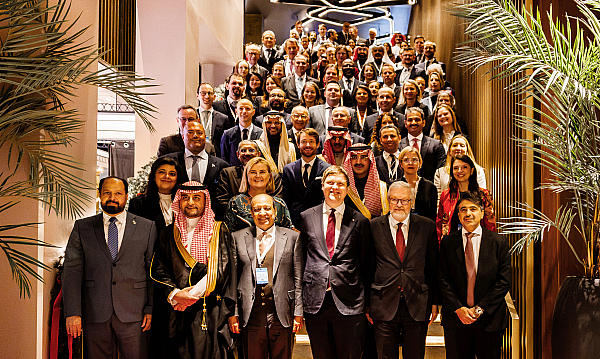
Members of the Arab Coordination Group (ACG) (www.theACG.org) and of the OECD Development Assistance Committee (DAC) met in Oslo on 24 and 25 November 2026 for the 2026 Arab-DAC Dialogue on Development. Held at a critical juncture for international development co-operation – marked by shifting geopolitical priorities, a widening financing gap for the Sustainable Development Goals (SDGs) and compounding crises – the Dialogue reaffirmed the value of a long-standing and trusted partnership, and focused on how Arab providers and DAC members can deliver more, and better, together.
The Dialogue was co-chaired by Ms Gunn Jorid Roset, Director General of the Norwegian Agency for Development Cooperation (Norad); Mr Fawzi Yousef Alhunaif, Director General and Chairman of the Board of Directors of the Arab Fund for Economic and Social Development (AFESD) and Chair of the ACG; and Mr Carsten Staur, Chair of the OECD DAC. Enriched by the contributions of international experts, discussions addressed two themes: the future of international development co-operation and ways of working, and scaling up blended finance for sustainable development, including in fragile contexts.
Partnerships built on horizontality and country ownership
Participants agreed on the need to build on proven models of co-operation and to work in broader partnerships to overcome the fragmentation of the development landscape. They stressed that horizontality – equal and mutually respectful relationships between partners – should lie at the core of these partnerships, together with country leadership, local ownership and alignment with national priorities.
Fragile contexts: a priority for joint engagement
Fragile contexts emerged as a key area for strengthened co-operation. Participants underlined the importance of applying development effectiveness principles in these settings, drawing on the complementary experience of Arab providers and DAC members, and of ensuring coherence across humanitarian, development and peace efforts. They exchanged views on support for recovery and reconstruction, including in the Syrian Arab Republic, and highlighted the value of information sharing, closer coordination and complementary engagement in support of ongoing international and regional initiatives. Consultations on these questions will continue.
Blended finance: from mutual learning to scale
Participants discussed how to mobilize additional and innovative resources, including private capital, while safeguarding development additionality – in areas such as youth employment and decent work, climate and infrastructure. They called for greater standardization of mobilization instruments and structures to enable scale, combined with the context-sensitive implementation that fragility demands, and for fuller use of the complementarities between development agencies, national and regional development funds, development finance institutions and multilateral development banks. Participants underlined that blended finance complements, and does not substitute for, concessional public development finance.
Participants welcomed the continuation and expansion of mutual learning under the Arab-DAC Partnership on Blended Finance for Sustainable Development, and expressed openness to further practical collaboration, including through joint blended finance country platforms, country policy dialogues, capacity-building workshops and joint participation in high-level events.
Distributed by APO Group on behalf of Arab Coordination Group (ACG).
About the Arab Coordination Group (ACG):
The Arab Coordination Group (ACG) is a strategic alliance that provides a coordinated response to development finance. Since its establishment in 1975, the ACG has been instrumental in developing economies and communities for a better future, providing more than 13,000 development loans to over 160 countries around the globe. The ACG works across the globe to support developing nations and create a lasting, positive impact. The Arab Coordination Group (ACG) is considered one of the most important and effective development partnerships at the international level. The group actively works to adopt the best global practices in sustainable development work. It also aims to align the efforts of these institutions to achieve convergence and harmonization in the policies governing their financing operations.
The Group comprises 10 national, Arab regional, and international institutions, including the Abu Dhabi Fund for Development, the Arab Bank for Economic Development in Africa, the Arab Fund for Economic and Social Development, the Arab Gulf Program for Development, the Arab Monetary Fund, the Islamic Development Bank, the Kuwait Fund for Arab Economic Development, the OPEC Fund for International Development, the Qatar Fund for Development and the Saudi Fund for Development.
About the Arab-DAC Dialogue on Development:
The Arab-DAC Dialogue on Development serves as a high-level platform for strategic engagement between the Arab Coordination Group (ACG) and members of the OECD Development Assistance Committee (DAC). The dialogue aims to strengthen cooperation, promote mutual learning, and advance innovative approaches to development finance and international development cooperation in support of sustainable and inclusive development.


