
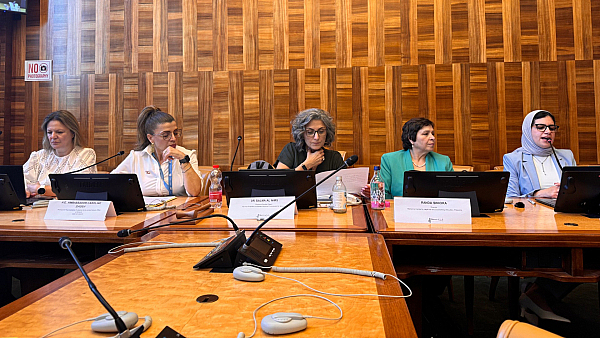

The Hurra Coalition (http://apo-opa.co/4gQAI5n) has called on governments and the international community to make family law reform a priority in the Middle East and North Africa, warning at the 62nd Session of the United Nations Human Rights Council that discriminatory laws are undermining women’s economic rights, hindering sustainable development, and impeding recovery and reconstruction in conflict-affected countries.
Family law reform is an economic development issue in the Middle East and North Africa
Across the Arab region, family and personal status laws governing marriage, divorce, inheritance, guardianship, child custody, and property rights are frequently based on patriarchal interpretations of religious rules that systematically deprive women of their financial rights.
Discriminatory family laws that restrict women’s legal capacity to make decisions about their lives and finances, or limit their rights to own property, inherit assets, or earn and control income, undermine women’s financial security and make them more vulnerable to dependency, poverty, and unjust treatment.
The consequences extend far beyond the individual, limiting economic growth and preventing families, communities, and countries from benefiting fully from women’s skills, labour, and leadership. Gender inequality embedded in family laws should not be treated solely as a private concern, as it is both a cause and a consequence of social instability, economic stagnation, and weak human rights protections.
Why family law reform is critical for women in conflict-affected Arab States
The Hurra Coalition is a regional network of 18 leading feminist human rights organisations working to advance equality in family and personal status laws across the Middle East and North Africa. Through collective advocacy, the Coalition is seeking to end legal discrimination against all women and girls throughout the Arab world.
With support from the Coalition co-founder and elected secretariat Equality Now (http://apo-opa.co/4eNpXzH), the Hurra Coalition hosted a high-level side event at the UN in Geneva on 25 June 2026, titled ‘Family Law Reform as a Foundation for Women’s Economic Justice and Resilience in Conflict-Affected Arab States’. The convening featured experts from the Coalition, speaking alongside UN representatives to highlight the urgent need for legal reform to address women’s economic empowerment.
In countries experiencing armed conflict, displacement, and political instability, such as Iraq, Lebanon, Libya, Palestine, Sudan, Syria, and Yemen, the promotion of women’s rights and family law reform is explicitly or implicitly deprioritised on the grounds that security, reconstruction, and humanitarian response must come first.
Naglaa Sarhan, Coordinator for the Hurra Coalition, emphasised the pressing need to prioritise discussions, explaining that at this critical moment, a growing number of Arab states are “simultaneously facing protracted conflict, economic collapse, and mounting political pressure to defer gender equality commitments in the name of national stability. We strongly believe that we cannot have actual and profound peace and reconstruction without having equal family laws, because the impact of discrimination does not stop during crises”.
Patriarchal power structures perpetuate crises, worsening gender inequality and gender-based violence while weakening legal safeguards for women. The collapse of formal state institutions during conflict often leads people to turn to informal or customary dispute resolution mechanisms that are less accountable, less transparent, and more likely to disadvantage women in family disputes, property claims, and protection cases.
Randa Siniora, the Director of the Women’s Centre for Legal Aid and Counselling (WCLAC) in Palestine, pointed out how the ongoing conflict in Gaza has exacerbated challenges faced by women and girls due to courts being rendered completely dysfunctional, leaving victims and survivors without access to justice.
Gender equality in family law is essential to post-conflict recovery
Periods of post-conflict reconstruction have historically been moments of both opportunity and regression for women’s rights. Importantly, it is precisely during and after conflict that equal rights within the family are especially critical to protecting women’s economic security and enabling them to rebuild their lives.
Adriana Quiñones, Chief of the Human Rights and Nondiscrimination Section at UN Women, remarked that “family law is not a lateral or isolated domain” because “governing marriage, divorce, inheritance, guardianship, and the financial rights of wives are structural barriers that shake women’s economic outcomes at every stage of life. Egalitarian reform of family law may be the most crucial precondition to empower women economically”.
Speakers at the UN event provided a range of actionable recommendations and highlighted that legal reform should be accompanied by broader efforts to dismantle the harmful social and cultural attitudes and practices that underpin women’s disadvantage.
Governments, UN agencies, donors, and other stakeholders are invited to work with the Hurra Coalition to accelerate legal reform and ensure women’s full and meaningful participation in the design and implementation of conflict recovery and nation-building.
Why family law reform in the Middle East and North Africa belongs on the global agenda
Emphasising the importance of raising family law reform at the UN level, Dr Dima Dabbous, the Middle East and North Africa Representative for Equality Now, explained, “The Hurra Coalition’s leadership in convening this UN Human Rights Council side event marks an important milestone in the Coalition’s evolution and demonstrates its growing capacity to drive advocacy at the highest level. Elevating family law reform up the international agenda is critical to overcoming entrenched local resistance against aligning domestic legal frameworks with international human rights standards.
“Family law reform can no longer be treated as a peripheral issue. It is a prerequisite for achieving gender equality, economic justice, sustainable development, and lasting post-conflict recovery across the Middle East and North Africa”.
Distributed by APO Group on behalf of Equality Now.
Social Media:
Bluesky: equalitynow.bsky.social (http://apo-opa.co/4eWjn8M)
Facebook: @equalitynoworg (https://apo-opa.co/4xX5mAn)
Instagram: @equalitynoworg (https://apo-opa.co/4weqCQf)
LinkedIn: Equality Now (http://apo-opa.co/4eNpXzH)
About Hurra Coalition:
The Hurra Coalition (http://apo-opa.co/4gQAI5n) is a regional network of feminist and human rights organisations across the Middle East and North Africa working to reform discriminatory family laws and ensure equality and justice for women and girls. Established in 2019 as an initiative by Equality Now and six founding members, it serves as a platform for solidarity, legal advocacy, and coordinated regional campaigning.
Today, Hurra includes 18 national women’s rights organisations from nine Arab countries, encompassing legal associations, research centres, anti-violence institutions, and development organisations. This diversity enables the coalition to draw on deep national expertise and collective regional strategies to advance reform.
About Equality Now:
Equality Now is a worldwide human rights organisation dedicated to securing the legal and systemic change needed to end discrimination against all women and girls. Since its inception in 1992, it has played a role in reforming over 130 discriminatory laws globally, positively impacting the lives of hundreds of millions of women and girls, their communities and nations, both now and for generations to come.
Working with partners at national, regional and global levels, Equality Now draws on deep legal expertise and a diverse range of social, political and cultural perspectives to continue to lead the way in steering, shaping and driving the change needed to achieve enduring gender equality, to the benefit of all.
For more details, go to www.EqualityNow.org.


