
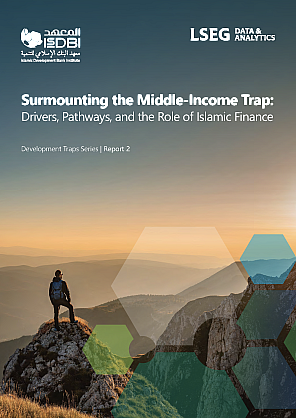
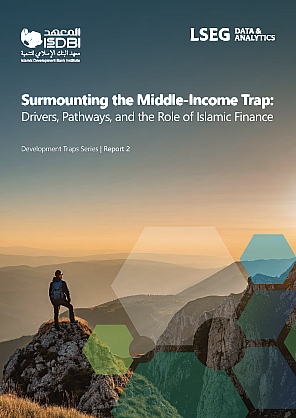
The Islamic Development Bank Institute (IsDBI) (https://IsDBInstitute.org/) and London Stock Exchange Group (LSEG) launched a new joint report titled Surmounting the Middle-Income Trap: Drivers, Pathways, and the Role of Islamic Finance.
The report was launched on 17 June 2026 during the 20th IsDB Global Forum on Islamic Finance, held in conjunction with the IsDB Group Annual Meetings in Baku, Azerbaijan.
This report is the second publication under the Development Traps Series. It examines the middle-income trap as a major long-term development challenge facing many IsDB member countries and presents policy-oriented analysis on how Islamic finance can support more inclusive, productive, and resilient development pathways.
Many IsDB member countries are still classified as middle-income countries. These economies often face challenges such as slow productivity growth, limited structural changes, financing difficulties, widespread informal economic activity, inequality, debt risks, technological gaps, and insufficient institutional capacity. These factors make it difficult for these countries to move from middle-income to high-income status.
Commenting on the launch, Dr. Sami Al-Suwailem, Acting Director of IsDBI, said: “The middle-income trap poses a significant challenge to development in many IsDB member countries. This report provides a timely analysis of the structural barriers affecting productivity, diversified and inclusive growth, and explores how Islamic finance can promote development through risk sharing, asset-backed financing, social finance, and instruments related to the real economy.”
The report argues that addressing the middle-income trap requires coordinated reforms, strengthened institutional frameworks, sustained investment in human capital, increased productivity, encouragement of innovation, economic diversification, and the development of financing models that support real economic growth.
The report also explores how Islamic finance can play a role in this effort. It highlights the potential of risk-sharing and equity financing, asset-backed financing, trade finance, sustainable financing, and hybrid financing, as well as Islamic social financial instruments such as zakāt, waqf, qarḍ ḥasan, and ṣadaqāt. These instruments can help the productive sector raise funds, support SME, promote infrastructure and innovation, foster financial inclusion, and support more resilient economic growth.
Mustafa Adil, Head of Islamic Finance, LSEG, said: “We are pleased to collaborate with IsDBI on this important report. By combining data-driven analysis, market perspectives, and Islamic finance expertise, the report offers a useful evidence base for policymakers, regulators, financial institutions, and development partners seeking to address long-term development constraints in middle-income economies.”
IsDBI’s contribution to the report aligns with its mission to support member countries through applied research, policy advice, capacity building, and knowledge solutions in Islamic finance and development economics. The partnership with LSEG highlights the benefits of merging expertise in Islamic finance with data-driven analysis and global market insights.
The report presents a segmented framework tailored for middle-income IsDB member countries and offers policy recommendations based on each country’s characteristics, development goals, and implementation abilities. It also details practical approaches for leveraging Islamic finance to promote structural transformation, productive investment, inclusion, resilience, and sustainable development.
This publication is designed to assist policymakers, regulators, financial institutions, development partners, researchers, and other stakeholders in addressing long-term development challenges in IsDB member countries.
The report is accessible on IsDBI website here: https://isdbinstitute.org/product/islamic-finance-middle-income-trap/
Distributed by APO Group on behalf of Islamic Development Bank Institute (IsDBI).
Social media handles:
X (Twitter): https://apo-opa.co/4gqkNur
Facebook: https://apo-opa.co/4xACk9g
LinkedIn: https://apo-opa.co/4euQKz6
About the IsDB Institute:
The Islamic Development Bank Institute (IsDBI) is the knowledge beacon of the Islamic Development Bank Group. Guided by the principles of Islamic economics and finance, the IsDB Institute leads the development of innovative knowledge-based solutions to support the sustainable economic advancement of IsDB Member Countries and various Muslim communities worldwide. The IsDB Institute enables economic development through pioneering research, human capital development, and knowledge creation, dissemination, and management. The Institute leads initiatives to enable Islamic finance ecosystems, ultimately helping Member Countries achieve their development objectives. More information about the IsDB Institute is available on https://IsDBInstitute.org/


