
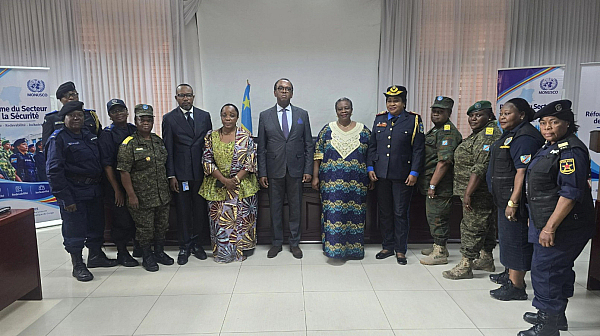

MONUSCO supports the integration of a gender perspective into Security Sector Reform (SSR) in the Democratic Republic of the Congo (DRC). On Wednesday, 11 November, it supported the organization of a workshop in Kinshasa aimed at raising awareness and strengthening the leadership capacities of women experts, executives and professionals working in the security sector.
In the Democratic Republic of the Congo, despite the progress made, women remain underrepresented in leadership positions and decision-making bodies within the security sector.
Sociocultural stereotypes
Yet the approximately 100 women who attended the workshop are convinced that the issue is not a lack of skills or expertise.
Faida Mwangilwa, focal point of the Women’s Advisory Group on Security Sector Reform, believes that it is essential for women to take a greater interest in security-related issues.
She says that numerous obstacles persist because of stereotypes. “Few parents are willing to allow their daughters to join the Armed Forces of the Democratic Republic of the Congo (FARDC), the Congolese National Police (PNC) and security services,” she observes.
These stereotypes were also highlighted in a study conducted in 2024 by the School of Criminology at the University of Kinshasa, with support from MONUSCO’s Security Sector Reform Division. The study assessed the barriers to women’s participation in the security sector in the DRC.
It specifically identified “institutional barriers” and “sociocultural stereotypes” as obstacles to “meaningful participation” in security and defence services.
The study further notes that these barriers “negatively affect women’s career development in the security sector: at the institutional level, some women, reduced to being objects of sexual gratification for their superiors, give up serving the nation under the flag and instead choose other activities that preserve their human dignity. Meanwhile, those who remain in the sector but resist harassment see their promotion files blocked.”
Women have the necessary skills
At MONUSCO’s Rule of Law and Security Institutions Division, there is a firm belief that women have the skills and expertise required to work in the security sector.
“Congolese women possess skills and experience that must be fully recognized and mobilized to help transform defence and security institutions. Our collective responsibility is to create the conditions that will enable them to exercise leadership and contribute to decision-making,” said Obianuju Nwobi, Head of the Division.
In her view, women’s participation in security sector governance “also contributes to the professionalism, effectiveness, accountability and legitimacy of institutions.”
The participants attending Tuesday’s workshop were primarily women experts, executives and professionals holding technical, administrative, operational or decision-making positions, as well as representatives of parliamentary institutions, women’s organizations and partner organizations.
The aim of the meeting was to increase women’s representation while equipping them with the means to effectively influence strategic decisions, public policy development and the implementation of reforms in the security sector.
However, as Obianuju Nwobi pointed out, “this requires fair conditions of access to recruitment, training, promotion and positions of responsibility, as well as a professional environment free from discrimination and harassment.”
Women’s leadership must be built
For his part, the Deputy Minister in charge of Customary Affairs, Jean-Baptiste Ndeze, welcomed the initiative, which brings together women from various institutions to seek solutions to improve their participation in leadership and decision-making roles.
“How can we claim to modernize our institutions if we do not fully mobilize all the skills and expertise at their disposal?” the Deputy Minister asked. He said he had listened carefully to the concerns raised by the women attending the workshop.
Jean-Baptiste Ndeze stressed that women must be able to “advance in their careers, access positions of responsibility and exercise their authority while meeting the same standards of competence, discipline and professionalism as their male colleagues.”
He further emphasized that training, promotions and appointments must be based on objective criteria.
“No professional ambition should be undermined by prejudice, discrimination, harassment or abuse of authority,” the Deputy Minister concluded. He explained that an institution that trains its personnel without giving them the opportunity to put their skills into practice deprives itself of part of its own resources.
At the close of the workshop, a framework for collaboration between women from various institutions and women’s organizations was established. Discussions will continue within this framework to gather as many proposals as possible to promote the emergence of women’s leadership within security institutions.
As the Deputy Minister for Customary Affairs pointed out, “Women’s leadership cannot simply be decreed. It is built through training, experience, trust and effective access to positions of responsibility.”
Distributed by APO Group on behalf of Mission de l’Organisation des Nations unies en République démocratique du Congo (MONUSCO).


