
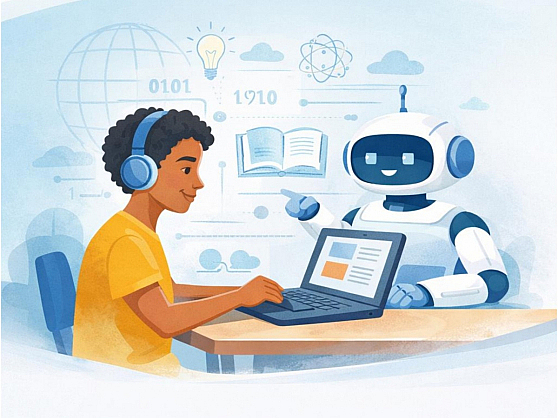

President Dr Patrick Herminie promised that technology would be central to his vision for Seychelles’ future. Last week, that vision reached directly into the country’s classrooms, with Cabinet’s approval of the National Artificial Intelligence (AI) in Education Framework 2026 – 2030, a landmark policy that will transform how AI is introduced and used across the country’s education system.
The Framework, developed by the Ministry of Education and Human Resource Development with technical support from the World Bank, provides the first comprehensive national roadmap for integrating Artificial Intelligence into teaching, learning, educational leadership, and school administration. It represents one of the most significant education reforms in recent years and places Seychelles among a growing number of countries developing national policies for the responsible use of AI in education.
The approval gives practical expression to a promise the President made from his earliest days in office. Shortly after assuming office, President Herminie declared:
“Our goal is to transform Seychelles over the next five years, with a strong focus on science, technology, and artificial intelligence.”
The newly approved Framework translates that vision into a practical implementation plan for every state school in the country and adds to a growing list of technology commitments the Administration has delivered since taking office, building on other technology initiatives undertaken by the Government, including the expansion of national connectivity through Starlink, likewise described by the Government as an election pledge fulfilled. For a President who has made innovation a defining theme of his agenda, the Framework is proof that the pledge extends beyond infrastructure and into the classroom, where it will shape the next generation of Seychellois learners.
Putting Teachers at the Centre of AI
Unlike many discussions around AI that focus primarily on technology, the Seychelles Framework places teachers firmly at the centre of the digital transformation.
It recognises that AI should enhance, not replace, the professional judgement, creativity, and expertise of educators.
To achieve this, the Framework introduces a comprehensive teacher development programme, including a four-level National Teacher AI Competency Framework, a mandatory AI micro-credential for all teachers, and the establishment of an AI Champion in every school to support colleagues in integrating AI into teaching and learning.
By investing in teacher capacity, the Ministry aims to ensure that educators are confident, competent, and equipped to use AI responsibly to improve learning outcomes, a commitment that speaks directly to the teachers who have long asked for support, not replacement, in a changing profession.
Preparing Learners for an AI-Driven Future
For learners, the Framework introduces a progressive approach to AI literacy from primary through secondary education.
Rather than creating a new standalone subject, AI concepts will be integrated across the existing curriculum, enabling learners to develop digital, critical thinking, problem-solving, creativity, and ethical decision-making skills that are increasingly essential in the modern world.
The Framework also reinforces Seychelles’ transition towards competency-based education by using AI to support personalised learning, formative assessment, and differentiated instruction, ensuring that every learner receives the support needed to achieve their full potential, a direct answer to families who want assurance that no child will be left behind as the country modernises.
Building Public Confidence Through Responsible AI
A defining feature of the Framework is its strong emphasis on ethics, transparency, and learner protection.
Recognising the opportunities and risks associated with AI, the policy establishes robust safeguards relating to data privacy, child protection, academic integrity, cybersecurity, and responsible procurement.
Importantly, high-stakes decisions, including final grading, certification, and student placement, will remain under human oversight during the initial phases of implementation.
This human-centred approach reflects the Ministry’s commitment to ensuring that technological innovation strengthens, rather than diminishes, the role of educators and the trust of parents and communities, the same trust the Administration has sought to build with every promise it has set out to keep.
Turning Policy into Practice
The National Artificial Intelligence in Education Framework is not simply a policy statement; it is already being translated into concrete action.
Earlier this year, the Ministry, in partnership with the Commonwealth of Learning, conducted a national workshop on Digital Competencies for Teachers, equipping educators with practical skills in the use of Artificial Intelligence and Open Educational Resources (OER) to design digital content, create engaging lesson plans, and enhance classroom practice.
The Ministry is also implementing two innovative AI pilot projects in collaboration with the World Bank.
The AI Teacher Coach Programme supports Primary 5 and Primary 6 teachers across six schools by providing AI-assisted guidance to strengthen lesson planning, classroom practice, and professional development.
At the same time, the AI Student Tutor Programme is providing personalised learning support to Secondary 3 learners in Mathematics and Geography across four schools, demonstrating how AI can be used to improve learner engagement and achievement while maintaining teacher oversight.
These initiatives will become integral components of the national Framework as implementation progresses, giving the President’s promise a head start before the ink on the policy itself has even dried.
A Coordinated National Approach
To oversee implementation, the Framework establishes a National AI in Education Steering Committee, which will coordinate policy implementation, approve AI tools for use in schools, monitor progress, and ensure compliance with national standards relating to ethics, quality assurance, and data protection.
The Committee will also maintain nationally approved and prohibited AI tools lists, ensuring that schools adopt technologies that are safe, effective, and aligned with educational objectives.
Investing in the Future
Minister for Education and Human Resource Development Ambassador David Pierre described the Framework as an investment in Seychelles’ people as much as in technology.
“In embracing Artificial Intelligence with wisdom, responsibility, and vision, Seychelles is not only shaping the future of its education system but also investing in the limitless potential of its people.”
As Artificial Intelligence continues to reshape societies and economies around the world, Seychelles is positioning itself not as a passive observer but as an active participant in shaping how these technologies can improve education.
The approval of the National Artificial Intelligence in Education Framework marks the beginning of a new chapter, one in which innovation is guided by ethics, technology is driven by purpose, and every teacher, learner and parent can see, in a policy now taking effect in their own schools, a presidential promise being kept, giving teachers, learners and parents confidence that Seychelles is embracing Artificial Intelligence in a responsible, ethical and purposeful way.
Distributed by APO Group on behalf of State House Seychelles.


