
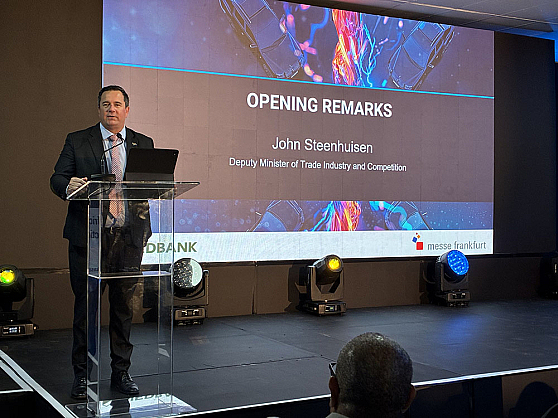
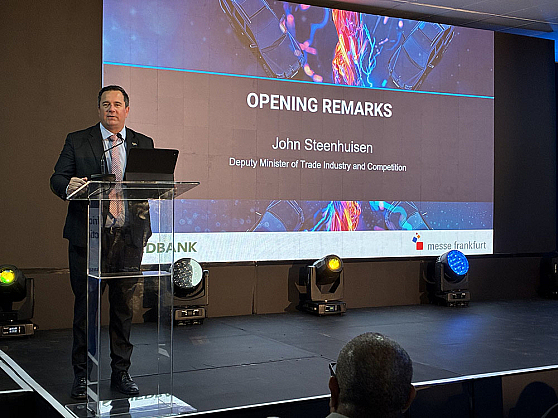
The Deputy Minister of Trade, Industry and Competition, Mr John Steenhuisen, has called for greater investment, localisation, skills development and export expansion in South Africa’s automotive aftermarket industry, describing the sector as a significant driver of economic growth, industrial development and employment.
Addressing industry leaders at the Automechanika Johannesburg 2026 CEO Breakfast at Gallagher Convention Centre in Midrand today, Steenhuisen highlighted the economic importance of an industry that traded approximately R933 billion in 2025, contributing R202.6 billion to GDP.
The sector supports more than 310,000 jobs, representing approximately 70% of automotive employment, across more than 23,000 businesses, predominantly small and medium-sized enterprises.
“These are not peripheral activities. They are central to South Africa’s economic resilience, industrial capability, and mobility,” said Steenhuisen.
With approximately 13 million vehicles on South African roads, averaging almost 11 years in age, and 76% outside their warranty periods, Steenhuisen emphasised the enormous potential to expand domestic manufacturing of replacement parts.
South Africa imported approximately R107.5 billion in replacement parts in 2025, presenting a substantial opportunity to strengthen local production, retain economic value and create employment.
“Every additional percentage point of localisation in replacement parts represents jobs created, industrial capability strengthened, foreign exchange retained, and value added within South Africa,” he said.
Steenhuisen stressed that the ongoing review of the Automotive Production and Development Programme (APDP2) should consider the broader automotive value chain, extending beyond vehicle manufacturing to the businesses supporting vehicles throughout their operational lives.
He also identified the African Continental Free Trade Area (AfCFTA) as an opportunity to expand South African exports of replacement parts, remanufactured components and specialised automotive services.
South Africa, he said, has the engineering expertise, established distribution networks and industrial capabilities to become a leading automotive aftermarket hub for Africa.
Addressing skills development, Steenhuisen expressed concern that South Africa has approximately 31% fewer qualified automotive artisans than in 2009, despite increasing apprenticeship numbers.
He called for stronger collaboration between government, industry and training institutions to prepare young South Africans for emerging technologies, including electric vehicles, advanced diagnostics and artificial intelligence-enabled systems.
Steenhuisen further highlighted road safety and the economic benefits of vehicle maintenance, noting that road crashes cost South Africa almost R200 billion in 2025, equivalent to approximately 2.8% of GDP.
Steenhuisen concluded by emphasising the need to translate economic opportunities into measurable results.
“South Africa must move from investment announcements to practical implementation.”
He reaffirmed his commitment to working with industry to remove barriers to growth, strengthen competitiveness, support small businesses and unlock employment opportunities.
“Localisation must extend beyond the factory gate. It must include the businesses that keep South Africans moving every day,” concluded Steenhuisen.
Distributed by APO Group on behalf of The Department of Trade, Industry and Competition, South Africa.


