
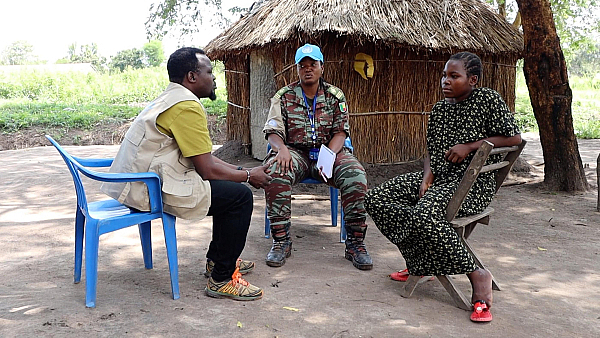

For Suzy John, farming is the only way to feed her five children. But each harvest season brings fear that armed groups may force her family from their land before they can collect the crops.
“We farm and harvest, but when we are ready to enjoy the fruits of our labour, armed groups come and drive us away,” she said. “Our houses were burned down, and now we are living under this tent.”
Suzy lives in Rii-rangu, a remote community in Yambio County, Western Equatoria State, where years of insecurity and poor infrastructure have left families without clean drinking water, functioning schools, healthcare or reliable access to markets.
Reaching Rii-rangu is difficult. Roads leading to the community are narrow, and often badly damaged by the rains. A patrol by peacekeepers with the United Nations Mission in South Sudan (UNMISS) traversed the challenging terrain to meet residents and assess their protection concerns, and urgent needs.
The poor road network has worsened the community’s isolation, limiting access to healthcare, education, markets and humanitarian assistance.
For women, the lack of essential services has created additional hardship.
“There are no schools, there is no borehole and no medical supplies,” said resident Hellena Mborihidie. “When someone falls sick, there is no medicine. We are pleading with the government to intervene.”
The members of the UNMISS patrol team met with residents, representatives of local authorities and security personnel in the area. They also assessed abandoned public facilities, including the damaged primary school and health centre.
Inside the damaged school compound, empty classrooms reflect the challenges facing children growing up in the area.
For mothers, the absence of healthcare and reliable transport has made pregnancy and childbirth particularly dangerous.
“There are no health facilities or medicines,” said Ojilia Barnaba, a mother of six. “Pregnant women have nowhere to receive antenatal care, and there is no transport to reach the nearest hospital.”
She said women and adolescent girls also lack access to menstrual hygiene supplies.
“There are no markets. When a woman or a girl is menstruating, there is no access to dignity kits. We are suffering.”
During the visit, the peacekeeping team documented the concerns raised by residents, including threats to civilians, displacement, food insecurity and the collapse of basic services.
After meeting with community members and listening to their grievances, UNMISS staff reassured them that these concerns would be shared with government authorities in the State.
“We are here as part of the UNMISS mandate to protect civilians and monitor possible human rights violations. We came to assess the situation, and we will report our findings to the UNMISS leadership,” said Senyo Kofi Dzamefe, a Military Observer with UNMISS.
Such patrols help the United Nations identify threats facing civilians and share information with authorities and humanitarian partners who can provide further support.
For the people of Rii-rangu, the priorities are clear: security, clean water, healthcare, functioning schools and safe access to their farms.
They want the opportunity to rebuild their homes, educate their children and live without fear on the land that sustains them.
Distributed by APO Group on behalf of United Nations Mission in South Sudan (UNMISS).


