
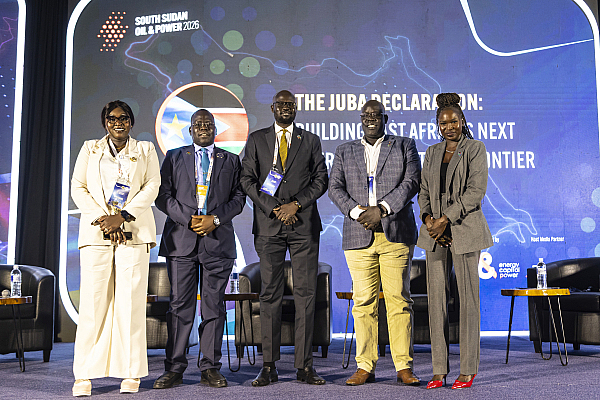

South Sudan will revise the exploration and production sharing agreement (EPSA) for frontier Block B2 and expects the South African National Petroleum Company (SANPC) to begin drilling or assessment immediately afterward, Eng. Lual Chol Dak, Director General of the Petroleum Authority, said on Wednesday at the closing session of South Sudan Oil&Power (SSOP) 2026 in Juba.
The session brought together the public and private-sector commitments made over the two days of the conference. It also laid out the contract terms, regulatory structure and financial conditions the government is offering to establish South Sudan as a secure destination for long-term capital. “I want you to be the first investor to encourage the others,” Dak told SANPC’s delegation.
The commitments presented at the close were made throughout SSOP 2026. Dar Petroleum Operating Company (DPOC) accepted a Ministry of Petroleum target of 120,000 barrels per day (bpd) by August 2027, while Sudd Petroleum Operating Company plans to reach 20,000 bpd in 2027. Greater Pioneer Operating Company reported three hydrocarbon discoveries in 2026, and Nilepet’s engineering subsidiary set out a three-year plan to build the capability to design and construct a refinery. Taken together, the commitments support the government’s goal of lifting national output beyond 200,000 bpd within two to three years.
Dak set out the protections the government is offering in return. Under the Petroleum Act 2012, policy sits with the Ministry of Petroleum, commercial participation with Nilepet and technical regulation with the Petroleum Authority. EPSAs run 25 to 37 years, subject to extension. Every upstream phase requires an environmental and social impact assessment. The ministry has pipeline, depot, refinery and central laboratory projects ready for negotiation. “We need real committed investors that can come and negotiate with us,” he said.
Dr. Jacob Dut Chol, Manager for Audit at DPOC, said the joint operating companies have internal audit and compliance systems in place, and the ministry reviews procurement awards and work program budgets.
“The JOCs are open for investment,” he said, adding that he expects a new joint operating company to emerge in the coming months.
Alam Chaat Paul, Head of the Diversified Sector at Stanbic Bank, said regional financial integration and simpler rules for moving money in and out of South Sudan would make investment decisions easier. Henry Kissinger Silvio, Acting Director General for Planning, Training and Research at the Ministry of Petroleum, said South Sudan’s regulatory frameworks must stay competitive with those of Kenya, Uganda and Ethiopia.
The ministry plans to offer five of the country’s 14 open blocks in an initial licensing round, with five more two to three years later. Investors entering the round will be able to weigh the revised Block B2 terms and the production commitments made at SSOP 2026 before they bid.
Distributed by APO Group on behalf of Energy Capital&Power.


