
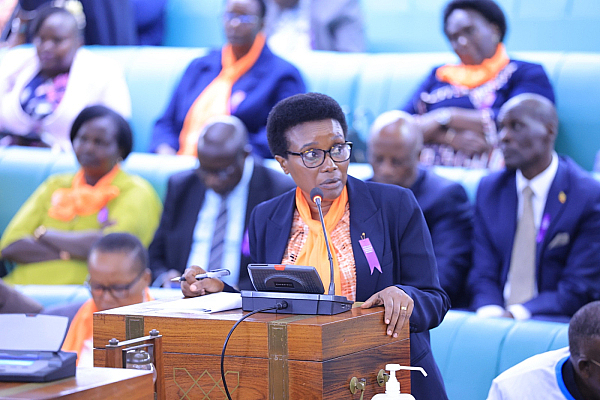

As Uganda embraces new technologies, digital violence against women is emerging as a growing concern, with serious implications for their mental health and well-being, the Minister of State for Gender, Labour and Social Development (Gender and Culture), Mary Kuteesa, has said.
“According to the study conducted by the Women of Uganda Network in 2021, an estimated 67 per cent of women who faced online violence, suffered stress, anxiety, depression and self-censorship including becoming less willing to express their opinions on social media, and others withdrawing from online spaces,” she said.
The Minister was presenting a statement on the 16 days of activism against Gender Based Violence (GBV) during plenary sitting on Thursday, 26 November 2026.
Premised on this year’s global theme, ‘UNITE! to ensuring justice, protecting survivors and ending impunity across online and offline spaces’, Kuteesa said that government’s objective of the campaign includes enhancing legal empowerment and digital literacy among women and girls.
“As the country celebrates expanded smartphone access, internet and, a rapidly growing number of Ugandans online, we must also note that violence has evolved with technology. The digital space has become a critical arena where women and girls face new forms of violence including the non-consensual sharing of intimate images, mobile money fraud, child sexual exploitation, and abusive political trolling among others,” she said.
Kuteesa added that online attacks also limit women’s access to online economic, financial and leadership opportunities.
“The risk is greatest for those with the least digital knowledge or support, including adolescent girls, older persons, and persons with disabilities and refugees, who may rely on mobile phones and mobile money without knowing how to protect themselves online,” said Kuteesa.
She also decried the increase in GBV related murders by 13.5 per cent, and an increase in emotional GBV from 29 per cent to 33 percent.
“In just 2025, we lost 208 women to domestic violence. Women in marriages are not happy, 6 out of 10 women in marriage have experienced sexual violence or emotional abuse,” she said.
She however said that the government has recorded a drop in sex- related offences by 12.6 percent from 14,425 cases in 2024 to 12,606 cases in 2025, while defilement cases have reduced by 14.8 percent from 12,312 in 2024 to 10,492 in 2025.
To further reduce cases of GBV, Kuteesa said government has accelerated access to financial facilities by women, including grants and loans such as the Joint Uganda Women Entrepreneurship Programme, Youth Livelihood Programme and the World Bank funded project, Generating Growth Opportunities and Productivity for Women Enterprises.
“A woman who is economically empowered can walk away from violence. As we conclude budgeting, every Ministry, sector, MP will understand that empowering women economically is key in eliminating GBV,” she said.
The Minister called on Parliament to expedite the enactment of the witness protection bill, the sexual offences bill, the legal aid bill and the marriage bill, saying that such laws are central in enhancing their access to justice especially for women, girls and those who are marginalized.
Deputy Speaker, Thomas Tayebwa deferred debate of the statement to next week, saying that GBV is a serious matter that requires ample time.
“Our mechanisms, be it in police or hospital check-ups do not allow women to report and successfully get the case to court. It is almost unthinkable for a girl who has been defiled or a woman who has been raped to tell you to travel 30 kilometers to hospital before you shower. Some of these need to be resolved expeditiously,” she added.
The 16 Days of Activism is a global annual advocacy campaign aimed at preventing and ending violence against women and girls. The campaign was inaugurated in l99l by the Women’s Global Leadership Institute (WGLI), at Rutgers University in New Jersey, United States of America (USA).
Distributed by APO Group on behalf of Parliament of the Republic of Uganda.


