
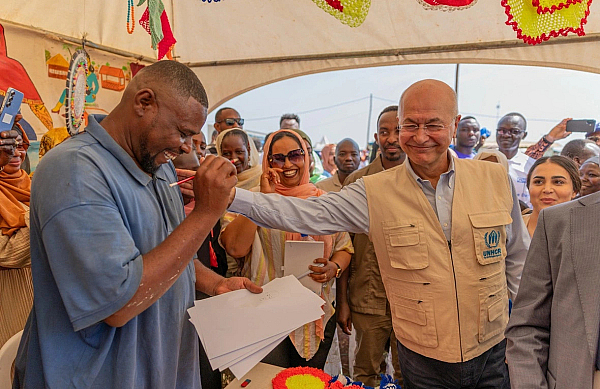
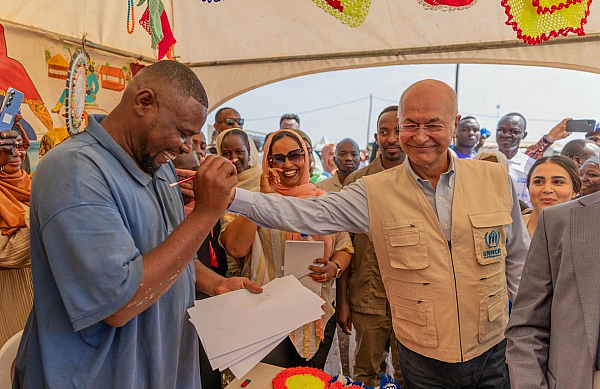
Ethiopia is one of Africa’s largest refugee-hosting countries, home to over 1.1 million refugees and asylum-seekers, including more than 45,000 refugees who have fled the conflict in neighbouring Sudan since April 2023. Ura settlement, in Ethiopia’s northwestern Benishangul Gumuz region, hosts more than 14,500 Sudanese refugees, who live alongside the local community and have access to the same services.
“Ura is more than just a refugee settlement,” Salih said at a World Refugee Day event that brought together the President of the Benishangul Gumuz region, refugees, local residents, government officials, and UN and regional partners. “It is a powerful example of what becomes possible when protection is combined with inclusion, when humanitarian action is linked to long-term solutions, and when refugees and host communities are given the opportunity to build their futures together.”
“On this World Refugee Day, we pay tribute to refugees and the host communities: to their courage, their resilience, and their determination to rebuild their lives despite enormous adversity,” Salih added. “Yet resilience alone is not enough. Refugees should not be expected to survive on resilience forever, nor should they spend decades waiting in limbo, dependent on humanitarian assistance, with little prospect of a better future.”
“We must invest in solutions. We must support host countries and communities. We must expand access to education, livelihoods, and documentation. And we must ensure that refugees themselves are active partners in shaping the policies and programmes that affect their lives,” he said.
At Ura settlement, Salih visited a primary school where young Sudanese and Ethiopian children learn side by side. He also met Sudanese refugee entrepreneurs who had opened businesses to support themselves and their families, as well as contributing to the local economy.
Among them was Mohyadin Ahmed Mohammed Ali, 37, who fled fighting in Sudan’s Al Jazeera State with his family, settling in Ura six months after first arriving in Ethiopia. A former merchant in Sudan, Ali slowly rebuilt his business in Ethiopia, initially by collecting and selling plastic bags before saving enough to open a small convenience store in Ura where he buys and sells food and other essential goods.
“When I came to Ethiopia, I got back to what I had been doing before. Business is getting better, and I don’t feel much difference from my status in Sudan [workwise],” Ali explained. “We don’t feel like foreigners. The country has shown us respect and consideration; one doesn’t need to go anywhere else. No one harasses us, and we can buy [and sell] like anyone else.”
Ali added that local officials have raised the possibility of applying for a business license, which he said would make it easier for him to travel to other parts of the country to buy goods and sell them in his store. He also highlighted the benefits of running a business alongside the local community in Ura.
“As a trader, if you do not mix and interact with local residents, other traders, and the community generally, you cannot trade,” he said. “I want to work for my children, so they can grow up and be educated.”
Two days earlier, in Addis Ababa, the High Commissioner joined Government ministers and officials to launch Ethiopia’s Makatet Roadmap – a framework for shifting from solely humanitarian relief to long-term development, transforming traditional camps into self-reliant urban settlements, integrated with national service delivery systems.
“With the launch of the Makatet Roadmap, the Government of Ethiopia transitioned from short-term humanitarian management to an inclusive development model that treats refugees as active contributors to our national growth,” said Ethiopia’s Minister of Finance, Ahmed Shide, at the launch event.
Back in Ura settlement, Salih said that such inclusive approaches were especially necessary at a time when humanitarian resources are under strain, and public debates about refugees become increasingly polarized.
“Here in Ura, you are showing that another path is possible. Refugees and host communities are proving every day that inclusion is not only possible – it works,” he said.
The High Commissioner also highlighted next month’s 75th anniversary of the 1951 Refugee Convention, which enshrines the “simple but profound promise” that anyone fleeing conflict or persecution has the right to seek safety in another country.
“At a time when that right is increasingly under pressure, we must defend it – firmly and collectively,” he concluded. “The world needs more examples like Ethiopia: examples that demonstrate that refugee protection and national development can advance hand in hand.”
Distributed by APO Group on behalf of United Nations High Commissioner for Refugees (UNHCR).


