
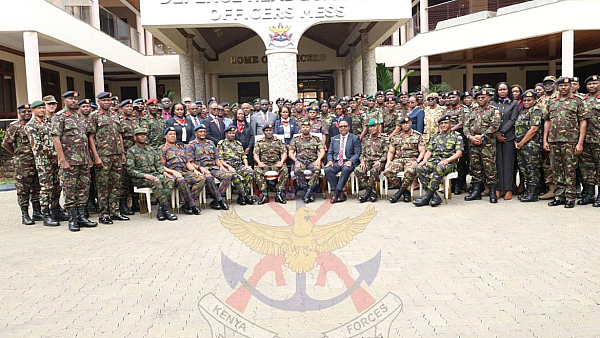

The interconnected nature of national security, good governance and sustainable development demands strategic leaders with a comprehensive understanding of defence institutions, their operational mandates and their contribution to national and regional stability. Exposure to military establishments and engagement with senior military leadership provide an essential platform for translating strategic knowledge into practical understanding.
On 24 November 2026, 80 participants of the National Defence College (NDC) Course 29 (2026/2027), including five participating virtually, undertook study visits to Defence Forces Headquarters (DFHQ), Headquarters Kenya Army and Headquarters Kenya Air Force.
Anchored on the theme, “Advancing National and Continental Security through Economic Transformation, Good Governance and Sustainable Development,” the visits formed part of the College’s strategic-level training programme, designed to broaden participants’ understanding of defence and security management.
At DFHQ, the delegation was received by the Vice Chief of the Defence Forces (VCDF), Lieutenant General John Omenda, who highlighted the significance of the visits in exposing participants to military organisational structures, institutional capabilities and the execution of defence mandates. He noted that such engagements broaden strategic perspectives and enhance appreciation of the complexities of defence and security management.
The Chief of Training, Kenya Defence Forces (KDF), Brigadier Alex Nteere, subsequently delivered a comprehensive presentation on the organisation, structure, roles and responsibilities of the KDF, highlighting its constitutional mandate of safeguarding Kenya’s sovereignty and territorial integrity, alongside its contribution to national, regional and international peace and security.
At Kenya Army Headquarters, the delegation was received by the Commander Kenya Army, Lieutenant General David Ketter, who emphasised the interdependence of security, good governance and sustainable development as fundamental pillars of national stability and prosperity.
He observed that sustainable development thrives in an environment of peace and security, while economic transformation and good governance contribute to national resilience and lasting stability. He further highlighted the Kenya Army’s operational responsibilities as the principal land component of the KDF, its contribution to regional stability and its role in addressing emerging security challenges.
At Kenya Air Force Headquarters, the Commander Kenya Air Force, Major General Bernard Waliaula, provided insights into the Service’s organisational structure, mandate and operational capabilities. He highlighted the strategic significance of airpower in safeguarding national security through air operations, surveillance and mobility, alongside its contribution to humanitarian assistance, disaster response, environmental conservation and other national development initiatives.
The engagements featured interactive sessions that facilitated intellectual discourse, knowledge exchange and a deeper appreciation of the complementary roles of the Services in advancing national security objectives.
The Commandant of the National Defence College, Lieutenant General Juma Mwinyikai, expressed appreciation to the military leadership for facilitating the visits, noting their significance in broadening strategic perspectives, fostering professional relationships and exposing participants to practical dimensions of strategic leadership.
Through such engagements, the National Defence College continues to nurture strategic leaders capable of navigating complex security environments, integrating defence and development perspectives, and advancing collaborative approaches to national and continental peace, security and sustainable development.
Distributed by APO Group on behalf of Ministry of Defence – Kenya.


