
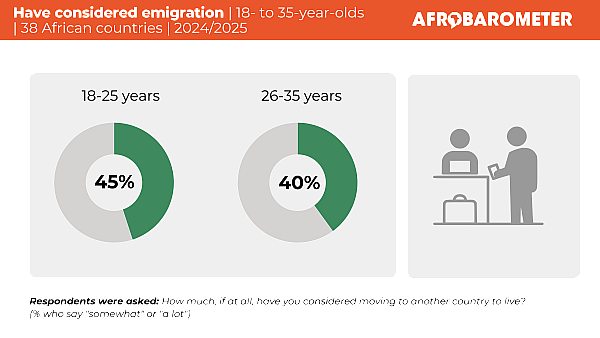
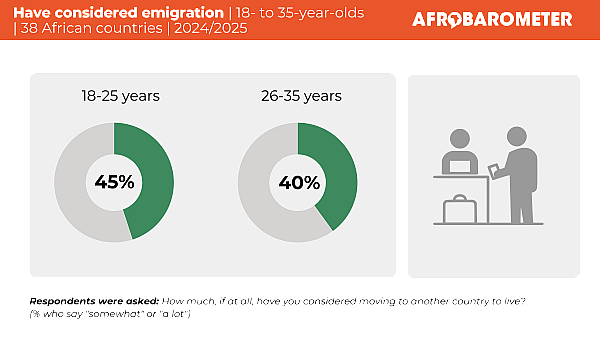
More than half of young Africans say they have considered emigrating, most to find better work and economic opportunities, according to the latest Afrobarometer (www.Afrobarometer.org) survey findings.
This reality was the focus of a #VoicesAfrica youth webinar (https://apo-opa.co/4g6Hqne) co-hosted Tuesday by Afrobarometer and the Nuru Trust Network to commemorate International Youth Day under the theme “Youth on the move: Rethinking migration and opportunity in Africa.” The discussion brought together youth advocates, researchers, gender experts, and practitioners to examine what young Africans’ migration aspirations reveal about employment, opportunity, governance, and the future they want to build.
Opening the discussion, Mary Yvonne Ododah, executive director of the Nuru Trust Network, urged stakeholders to look beyond the question of whether young Africans are leaving and focus instead on what would make staying, moving, or returning a real option.
“The bigger question is what would make staying a genuine choice?” Ododah said. “What would make moving a safe choice? And perhaps most importantly, what would make returning and contributing at home a very attractive choice?”
She noted that young people’s desire to emigrate is not a rejection of Africa but an affirmation of hope as they seek jobs, education, business opportunities, and the chance to build a better future.
Afrobarometer findings presented by monitoring, evaluation, and learning officer Kofi Otu Beecham show that 55% of 18- to 35-year-olds across 38 African countries have thought “a little bit,” “somewhat,” or “a lot” about emigrating. Among young potential emigrants, 52% cite better work opportunities as their main reason, while 18% wish to escape economic hardship.
The findings also show that young people are not only looking outward: Job creation is their top priority for investment in youth by their own government, followed by education, job training, and access to business loans.
A panel discussion explored factors behind these aspirations and what governments, civil society, development partners, and regional institutions can do to expand opportunities for young Africans.
Participants highlighted weak employment opportunities, skills gaps, limited access to finance, gender inequalities, weak trust in institutions, and gaps in regional economic integration as some of the factors shaping young people’s choices. They also cautioned against treating migration solely as a security concern for receiving countries, noting that unsafe migration routes can expose young people to exploitation, trafficking, and recruitment by criminal and armed groups.
The speakers further called for greater investment in Africa’s young population and more meaningful partnerships that respond to local priorities. They stressed that regional and continental frameworks must translate into tangible opportunities for the young people they are intended to serve.
The message emerging from the discussion was clear: Migration should be a choice, not an escape route. Creating the conditions for young Africans to thrive at home will require turning their aspirations into concrete opportunities.
Distributed by APO Group on behalf of Afrobarometer.
For more information, please contact:
Maame Akua Amoah Twum
Afrobarometer communications manager
Telephone: +233208326343
Email: maameakua@afrobarometer.org
Visit us online at www.Afrobarometer.org
Social Media:
Follow our releases on #VoicesAfrica
About Afrobarometer:
Afrobarometer (AB) is a trusted source of high-quality data and analysis on what Africans are thinking. With an unmatched track record of 440,000+ interviews in 45 countries,
representing the views of more than 75% of the African population, AB is leading the charge to bridge the continent’s data gap. AB data inform many global indices, such as the Ibrahim Index of African Governance, Transparency International’s Global Corruption Barometer, and the World Bank’s Worldwide Governance Indicators. The data are also used for country risk analyses and by credit rating and forecasting agencies such as the Economist Intelligence Unit. All AB data sets are publicly available on the website (www.Afrobarometer.org) and may be analysed free of charge using AB’s online data analysis tool. (https://apo-opa.co/4hGZlSF)


