
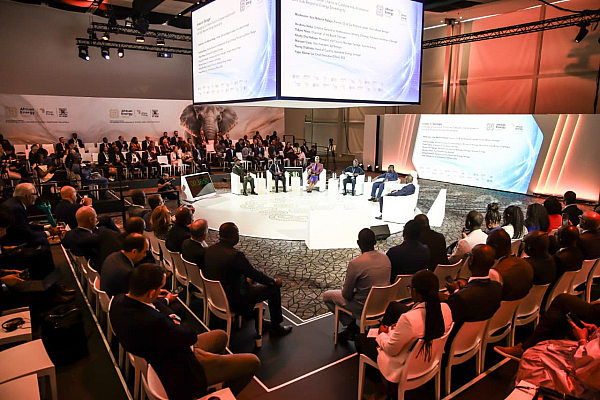
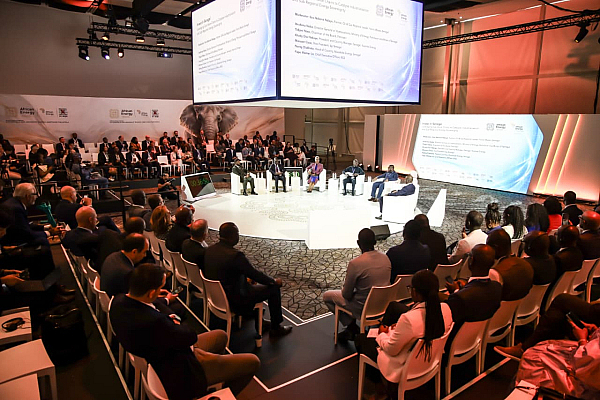
Senegal has 104 oil and gas blocks available to investors and is seeking new upstream contracts to accelerate exploration and production, El Hadji Abdourahmane Diouf, Minister of Energy and Petroleum, said at African Energy Week 2026 in Cape Town. Of the 113 blocks in Senegal’s reorganized acreage, four are under contract and five have been allocated to Eni for studies, leaving substantial opportunities for international and regional operators.
“We hope to sign a number of contracts…” he said, adding that the country aims to “show investors that Senegal remains the country it has always been: open, hospitable and respectful of international procedures.”
Senegal reorganized its upstream acreage into 113 blocks in March 2026, comprising 65 onshore and 48 offshore blocks. The country also signed an agreement with Eni to assess the oil and gas potential of five offshore blocks.
Beyond new exploration acreage, Senegal is seeking partners to develop the Yakaar-Teranga gas project alongside national oil company Petrosen. Petrosen took full control of the project after Kosmos Energy withdrew in April 2026. Minister Diouf said Yakaar-Teranga will supply gas for power generation, industrial applications including fertilizer production, and exports. Advancing the project will require a coherent development structure, credible buyers and a clear investment program.
“Our strategy is to build the value chain from the well to the factory, with gas at the heart of our industrial ambition,” he said.
Downstream, Minister Diouf pointed to a planned second refinery that will process Sangomar crude, with investment estimated at $2 billion to $3 billion. The Société Africaine de Raffinage (SAR) and Turkey’s Yamata signed a Memorandum of Understanding for the four-million-ton-per-year refinery in New York on September 23, 2026. Minister Diouf said the project opens further opportunities in storage, logistics, distribution and petrochemicals.
Minister Diouf invited investors to examine Senegal’s data, work with its technical teams and bring proposals backed by the capacity to invest and execute. He also asked partners to involve Senegalese companies and skills from the outset, with support from the national local content monitoring committee.
“Capital must earn a return. Senegal must gain a stronger economy. The partnership we seek must serve both purposes,” he said.
According to Minister Diouf, Senegal hopes to expand the MSGBC alliance beyond its five host countries of Senegal, Mauritania, The Gambia, Guinea-Bissau and Guinea, but he did not specify which countries are being considered.
Distributed by APO Group on behalf of African Energy Chamber.


