
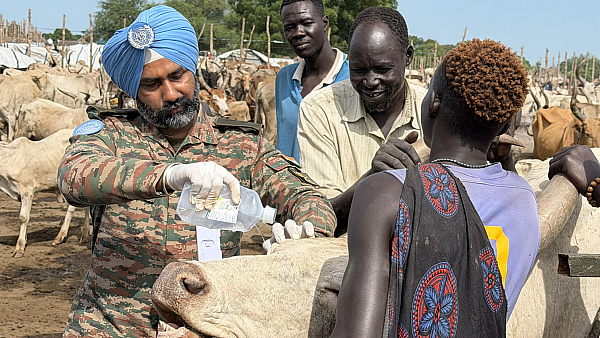
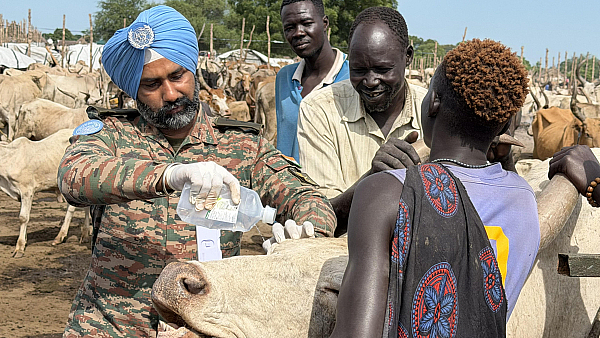
For many communities in South Sudan, livestock are far more than animals. Cattle provide food, income, and security. In Jonglei, where veterinary services are scarce, disease outbreaks can threaten the livelihoods of entire households.
Over the past year, Indian peacekeepers serving with the United Nations Mission in South Sudan have been helping protect these vital assets through mobile veterinary clinics, free treatment, community training, and veterinary education.
Since launching the outreach programme last June, the Indian veterinary team has treated more than 41,500 critically sick cattle and goats across remote parts of Jonglei, tackling infections, tick-borne diseases, parasitic illnesses, traumatic injuries, and other life-threatening conditions.
They have also provided free medicines, feed supplements, and advice on disease prevention and livestock management.
For cattle keeper Daniel Garang Jok, the regular visits have become a lifeline.
“This team of veterinary doctors has been very helpful. They have been visiting almost every week to assess our cattle, provide treatment, and offer advice. The more they help us keep our cattle stay healthy, the more we can remain on our land instead of moving elsewhere, where cattle movement can lead to conflicts with farmers.”
Healthier livestock means families are less likely to move in search of pasture, helping reduce tensions between pastoralists and farming communities.
But the initiative goes well beyond treating sick animals.
It is also strengthening local capacity. Over the past year, 252 Community Animal Health Workers have been trained to diagnose common diseases, provide basic treatment, support vaccinations, and promote better animal husbandry. Notably, 165 are women, expanding their role in protecting household livelihoods and creating new opportunities for economic independence.
One trainee, Makech Mabior Anyieth, says the practical training has transformed local responses to livestock diseases.
“I have attended their training three times. We learned how to dehorn cattle with defective horns, castrate animals, provide basic veterinary treatment, and carry out vaccinations.”
The initiative is also investing in South Sudan’s future veterinary workforce. Forty students from Dr. John Garang Memorial University of Science and Technology have received hands-on clinical training in disease diagnosis, treatment, surgery, and livestock management.
For many communities, the support fills a critical gap. For cattle keeper Awuoi Kur, the benefits are already visible.
“They have provided medicines and services that we could not access on our own. Some of the medicines are not available in local markets or even neighbouring countries, and they provide them free of charge.”
For Lieutenant Colonel Harmanjett Singh Goraya, Veterinary Officer with the Indian Battalion, the mission is about addressing one of South Sudan’s most pressing but underserved needs.
“Mobile veterinary camps are addressing widespread diseases including foot-and-mouth disease, East Coast fever, anaplasmosis, tick infestations, parasitic infections, and skin diseases while educating livestock owners on prevention and better animal management.”
Beyond treating livestock, the initiative will leave a legacy of community resilience that long outlasts the life of the peacekeeping mission.
Distributed by APO Group on behalf of United Nations Mission in South Sudan (UNMISS).


