

Finance Minister Hon. Henry Musasizi has called for deliberate action to unlock Uganda’s tourism potential and increase the sector’s contribution to the economy, with Government targeting US$5 billion in annual tourism receipts by 2030.
Musasizi said achieving the target will require more than increasing visitor numbers, with Uganda also focusing on longer tourist stays and attracting high-value visitors.
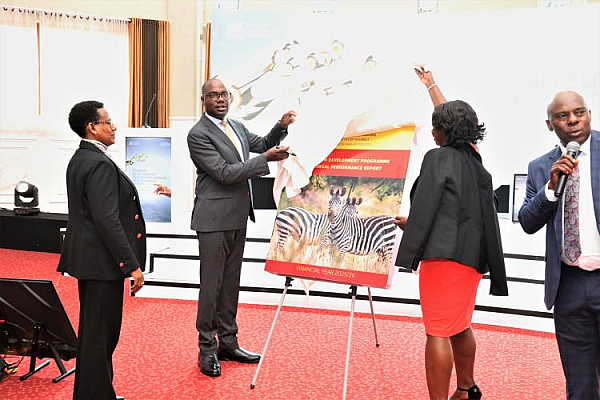
He made the remarks while officiating the 4th Annual Tourism Development Programme Review Conference at Imperial Royale Hotel, where he said tourism remains a high-priority sector for the country.
The latest Tourism Development Programme Annual Performance Report FY2025/26 shows that Uganda received 1.64 million international tourists in 2025, up 19.7% from 1.37 million in 2024. Tourism receipts increased by 21.3% to Sh5.83 trillion (US$1.62 billion), driven by higher visitor spending and longer stays.
The average length of stay rose from 8.7 nights in 2024 to 8.8 nights in 2025, while average tourist expenditure per trip increased to US$986, up from US$933 in 2024. Leisure tourists stayed an average of 9.5 nights, while visitors coming to see friends and relatives stayed 11.3 nights.
The momentum continued into 2026. Between January and June 2026, Uganda recorded 793,815 international visitors, representing a 3.7% increase from 765,307 during the same period in 2025. Tourism expenditure during the six months reached approximately Shs 2.30 trillion (US$631 million), a 25.6% increase compared with the same period in 2025. The average length of stay also increased from 7.4 to 8.3 nights.
Musasizi said Government’s role is to create an environment that enables the private sector to invest, expand tourism facilities, improve standards and attract foreign direct investment through partnerships and joint ventures.
He called for stronger public-private partnerships to turn tourism opportunities into viable and bankable investments across hotels and conference facilities, eco-tourism, cultural and heritage tourism, faith-based tourism, agro-tourism, sports, wellness, adventure, creative and entertainment tourism, and emerging digital tourism products.
The sector currently directly generates 876,512 jobs, equivalent to 7.5% of Uganda’s total employment, according to the Tourism Satellite Account. Tourism directly contributed Sh6.99 trillion, or 3.3% of GDP, in 2024.
Musasizi said Government will continue investing in tourism infrastructure, destination marketing, product development, conservation, specialised skills and digital transformation, while improving the business and investment environment.
He also pointed to affordable financing and fiscal incentives for investors, alongside Economic and Commercial Diplomacy to promote Uganda in international markets.
The Minister urged stakeholders to deliberately discover, develop, package, market and sustainably manage Uganda’s tourism assets while ensuring that the sector creates jobs, earns foreign exchange and benefits communities.
“Tourism is a source of high economic growth, earns the country significant foreign exchange, creates jobs for Ugandans, redistributes income to rural areas, and gives us a compelling reason to protect our nature,” Musasizi said.
Susan Nakawuki, the State Minister of Tourism said Government’s efforts in tourism marketing, infrastructure development and product diversification are beginning to yield results, noting the expansion of Uganda’s visibility on international markets and collaboration with Uganda’s missions abroad and local governments.
The Minister highlighted the construction of more than 280km of tourism roads, expansion of Entebbe International Airport, development of Kabalega International Airport and commencement of Kidepo International Airport. She also commended efforts to diversify tourism products and protect the country’s cultural and natural heritage.
She, however, called for more investment in tourism infrastructure, stronger marketing and promotion, faster product development and improved skills for people working in the sector.
Distributed by APO Group on behalf of Ministry of Finance, Planning and Economic Development, Republic of Uganda.


